Wednesday, May 1, 2013

Hype-Worthy Happenings in the Vineyard


The arrival of Spring in the Napa Valley brings with it a quintessential transformation of gray and gloomy to green and full of life. It's the time of year when the atmosphere in the valley is as close to perfection as we ever see--the vines are topped with a lush canopy of leaves and each day rises a few degrees warmer.


Flowering


2012 being my first harvest in the valley, the thing that strikes me the most in the midst of this lovely season is a feeling that even in these mild spring months, the vineyard is progressing in small ways towards the ultimate end--harvest. I try to stay aware of what's going on in the vineyard, to remain connected to its life cycle even in the less eventful or visually appealing months. But budbreak this year caught me by surprise. It dramatically altered my frame of mind with regard to the passing of time, and pulled me into the vineyard calendar: a year within a year that begins with budbreak and ends with harvest. I am now acutely attuned to the fact that everything happening outside the doors of the winery--the fog, the traffic on the highway, the birds chirping, the wind blowing, plays a role in this year's harvest. That may mean a tiny, even infinitesimal role, but there is still something to the idea that everything is connected.

The changing of the seasons also brought my attention to the purpose of identifying a wine's vintage. When we list this defining detail on the bottle, it serves to distinguish the wine from past and future years, but it also suggests that the wine exists as a product of the entire year of 2013--not just the few months leading up to harvest, which are historically far more celebrated. But the truth is, every day counts. Today for instance, the grapes are in the equivalent childhood of their lives! Following budbreak, we are now seeing flowering, which is when the future grape clusters are fertilized and pollinated. They are ultra-tiny and vulnerable and are being gradually nudged into full-fledged versions of themselves with the warm, but not yet scorching rays of the sun. So I dedicate this post to welcoming the development that is currently happening in the vineyard, to deem it equally as important as the exciting final days of ripening that receive so much hype. Flowering is the new harvest!


Wednesday, February 27, 2013

Peju Prunes


Pruning Party
 Last week was Employee Pruning Day at Peju! No, that is not a euphemism for layoffs, it's a chance for all of our employees to try their hand at pruning the vines and learn a bit about the science behind the process. And we were all blown away with how much we did learn.


Alejandro teaching

And showing us how it's REALLY done
Manuel and Alejandro were our gracious and patient guides. They explained which parts of the vine should go, which should stay, and why. Much of the process consists of getting rid of older shoots, which left untended could begin to take over the vine and drain nutrients and energy from the rest of the plant. Ideally, you leave a smaller shoot that is just hefty and strong enough to support an adequate number of clusters. Next year, that same shoot will be removed to make room for smaller growth beside it.

We also had to be mindful about training the shoots up towards the sky, which meant pruning anything growing sideways or downward. And on top of that, we learned to be liberal and decisive with the shears in order to avoid overcrowding and superfluous growth. After all, it's quality over quantity so we did not need to facilitate as many clusters as possible from one vine. Instead, we learned that the focus of pruning is to maintain a healthy vine with streamlined, consistent, and balanced growth.

With all of that information bouncing around in my head, I grabbed my shears and got to work on the vine, which I completed in just a minute or two. And I was extremely proud of it. I then watched Manuel do the same thing in about 5 seconds and realized my stark incompetence. There is so much to consider so I was amazed at how they these guys are able to break it down into a formula and execute so quickly. Practice makes perfect I guess, but most of us were nowhere near perfection!

A great experience and thank you so much to our winemaking and vineyard team!


Wednesday, February 13, 2013

Mustard! And everything that comes with it.


It's mustard season! Time to frolick through the yellow flowers, take hundreds of pictures, and soak in the beautiful sights before it all disappears into the ground. There is really nothing like it, so enjoy.


But pictures of mustard alone does not a blog post make. Beyond the bright and happy feeling these millions of yellow flowers bring to the valley, the mustard plays a serious and important role that touches the core of what viticulture and winemaking is all about.

To explain, the vineyard is a major part of the valley's ecosystem and the microcosm of Rutherford. As we look closer, we see that the vineyard is a living, breathing network of organisms on its own. A network that somehow produces beautiful wine, provides dozens of jobs, and offers entertainment and leisure for thousands of visitors each year. No small feat. But let's add to that. Because we practice organic agriculture, the vineyard is not just a gigantic, interconnected system that facilitates so many amazing things (wine, quintessential pastoral beauty). It is also a gigantic, interconnected system that will sustain itself for years to come, and operates on nothing but sun, earth, rain, insects, and in the words of Kung Fu Panda, "universe juice".
And one significant cog in that wheel of sustainability is the use of cover crops. Namely, mustard, beans, oats, and wildflowers that have a symbiotic relationship with the vines. As these plants grow they fulfill many, many tasks that include fortifying the soil with beneficial nitrogen, soaking up water from heavy rains that might otherwise go undrained (bad), and attracting beneficial insects that ultimately predate smaller pests. So as you marvel at the fluorescent blossoms, don't forget how important they are to the big picture, and each picture you take will mean that much more!


Thursday, January 10, 2013

A Renewed Love for Napa in 2013


“Why are American wines so expensive?”, asks a polite, but skeptical middle-aged couple from Germany. “At home, we never buy wine at such a price”. They both gesture to the twenty-two dollar bottle of Sauvignon Blanc on the counter between us. Immediately I feel my face start to flush. How do I explain, without a shred of pretention, why you, my adorable, inquisitive tourists, should be shelling out wads of cash for wine, when you live in a legendary, ancient wine-growing region?

Before a moment has passed, I realize there are plenty of reasons why our wines are priced at this level. As an East Coast transplant to the area, it is apparent to me that Napa is special, and the wines made here are quite rare. Driving through vineyard after vineyard, the farming spirit is in the air and the interconnectedness of it all is palpable. From sunshine, to leaves, to grapes, to press, to barrel, to bottle, the valley is a place where the line between wine and culture is quite blurry. The same is true for the sleepy river villages of the Mosel valley in Germany, for example.
But one difference is clear—that of age. While we are respectably established as one of the world’s great wine regions, when compared to France, Italy, Spain, and Germany, we are still viewed the young guns on the scene. The beauty of my argument, however, is that I consider it a good thing.  

I go on to explain that in Napa, you do not have to be born into the business, inheriting your share of a centuries old chateau in order to be successful. In Napa, the spirit of the American Dream still whispers through the vines. It is a place that has been developed and transformed over the last 40 years by adventurers and audacious entrepreneurs, (Tony and Herta Peju included) and continues to reinvent itself and give way to possibility year after year (Enter Ariana and Lisa).
And while the title of vintner/proprietor is a noble one, it is not always a smooth road or an easy life. Prices reflect the monetary investment as well as the emotional one!

When this heartfelt monologue garnered only a few nods, a smile, and a shrug, I pushed sentiment aside and turned to the stats: Napa is small. It spans a mere 30 miles from north to south, and at some points is only 1 mile across. And although a vast portion of this land is vineyards, the Napa Valley accounts for only 4% of California’s wine. In a word, it is unique, and its wines are precious gems. That, in my mind, accounts for every penny and more.

As for my new German friends, they were won over by the facts and figures. They bought the bottle of Sauvignon Blanc, went out to the terrace and soaked up the *January* California sunshine with a glass of wine in hand.

Wednesday, November 21, 2012

Giving Thanks for Fall at Peju


Early this week, the fog and rain rolled in like a veil to cover the Napa Valley, signaling the end of harvest and the changing of the seasons. Surrounded by a thick mass of clouds, the valley feels insulated from the outside world, as if hibernating in observance of the end of the grapes' journey from vine to winery. Droves of trucks barreling down the highway with back beds stacked with grapes have ceased. The air is damp, still, and quiet. Even the vines themselves seem relieved of their duties and thankful for the moisture. Several weeks after relinquishing their grasp on each grape cluster, bringing their singular task to completion, they now soak up the water and begin the slow fade into winter.

This in-between period immediately following harvest is really an interesting time for the vines.
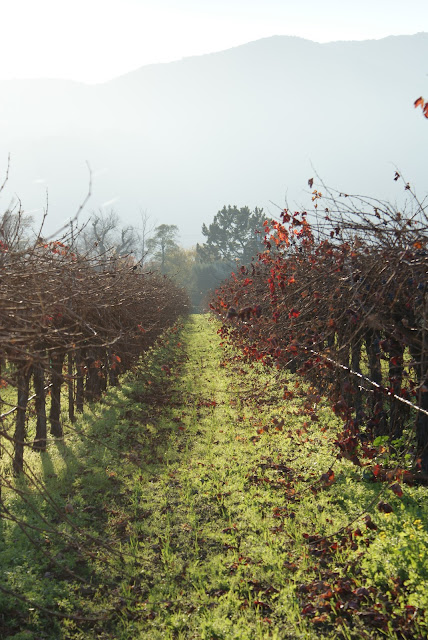
They still possess a vitality that their time spent fostering and nurturing the grapes affords them but have not yet declined into dormancy. Instead, they perform one final, wondrous transformation--their leaves turn from brilliant green speckled with gold, to a deep, burnt orange that makes the vineyard look like rows of flame. And for that we are thankful!

Enjoy the photos of the vineyard and Happy Thanksgiving from Peju!


Wednesday, November 7, 2012

Back In The Cellar


From below
 
 
From above
 
All of the picking for Harvest 2012 is officially finished, but the work does not end there. As the focus moves inside of the cellar, it is clear that while the taste of the vineyard does not hinge on following procedure after complicated procedure, it does require some thoughtful decision making about which are the most effective practices for making great wine. These practices often surround treating the grape with care, and avoiding too much manipulation of its flavors. But the thread that seems to run most clearly through Peju’s winemaking philosophy is that the easy way is not always the right way, and there are no shortcuts.  
I stumbled upon a perfect example of this as I wandered through the cellar last weekend. There were only a couple of people working back there, and they were responsible for pump-overs, or the process of racking the wine off the skins and then reintroducing it to the grape solids.

A simple pump-over is a vigorous process, one that ultimately tries to achieve maximum flavor extraction and oxidation in a minimal amount of time. At Peju, however, and at many wineries committed to attaining the very best wine from their fruit, this process is done in a more drawn out, gentle fashion referred to as "delestage". Instead of spraying the wine directly back into the same tank, the wine is transferred to a separate vessel and given time to recalibrate and settle down. This complete separation of liquid from solid components not only aerates the wine, but also allows the skins and seeds in the first tank to experience the pull of gravity. With the wine transferred to another tank, the grape solids sink to the bottom, which allows them to compress under their own weight and even extracts more fermenting juice.
When the wine is then reintroduced, it experiences further aeration, and the process is gentler and more thorough than if the wine were racked immediately back over the top.
By repeating these steps throughout the fermentation, the winemaker extracts as much flavor as possible from the tannins, as well as oxidizes the wine just enough to make them more elegant, and less astringent. This makes for a wine that will drink well upon its release, but have a cellar life of up to ten years or more.


Thursday, October 25, 2012

Reserve /rɪˈzɜrv/ [ri-zurv] noun, adjective

 
From here

To there
We are not quite done with Harvest, as fruit from our Rutherford estate is still being picked. These are the grapes that will eventually become our Estate Reserve wines.
The term “Reserve” in the wine world means many things for many different wineries. And in the US, there are no rules or regulations for what qualifies a wine as a “Reserve”. That being said, Peju’s Reserve wines are truly special, a representation of what happens when proprietors and winemakers take the time to learn about their vineyard and discover where the very best fruit comes from, and what that exceptional fruit is capable of when treated with love, respect, and attention.  

Our Estate Cabernet Sauvignon Reserve, Cabernet Franc Reserve, and H.B. Cabernet Sauvignon Reserve all come from specific blocks, and are then fermented, aged, and blended in such a way that further reveals their beauty and complexity. So "Reserve" at Peju has a "Vineyard Designate" status, but it is also essential to understand that the given vineyard is quite small. And due to that smaller size, the wine exudes what we refer to as "terroir". Not necessarily an earthy taste, but a sense of place, a feeling that comes from drinking a wine grown in a concentrated area with its own microclimate and history. Then, as it continues to be produced year after year after year, what is indicated on the label begins to signify something more and more tangible and recognizable.

And the best part is, despite all of the writing and scoring and analyzing we do, the only way to experience this is by drinking the wine. Cheers! And be sure to look out for the 2012 Rutherford Reserves in about three years when they are finally ready to drink...the valley is in unanimous agreement that 2012 is going to be an outstanding year.

Wednesday, October 17, 2012

The Magic of Yeast


The heavenly smell of fermenting red wine now fills the winery, and we have the power of yeast to thank for that. Yeast plays an essential role in winemaking as it converts sugar into alcohol. Without it we would have nothing more than old grape juice.

However, jumpstarting the process is a bit more complicated than dumping some yeast into a tank, so I looked over some shoulders today as we gave the yeast some TLC before inoculating.
When preparing a yeast culture, first it is necessary for the yeasts to be combined with a high temperature liquid. The heat allows the yeast to disperse throughout the liquid and keeps the yeast cells stable.
From there, the yeasts must be slowly and carefully cooled down, so that they can be transferred to the grape must, which is typically kept at around 58 F. Inoculating when the must and yeasts are within about ten degrees of each other ensures the yeast makes a smooth transition and doesn't experience any "cold shock", which could negatively affect the fermenation process.
For the yeast required for just one tank, this temperature adjustment process takes an entire day. Then the yeast is finally introduced to the must, they get to work on eating those sugars, and we get to go home. Just one of hundreds of examples of how in winemaking, the little tasks and details create a final product that is far, far greater than the sum of its parts. :)

Wednesday, October 10, 2012

How Far We've Come


There is a certain relief that comes with knowing much of Peju's Cabernet Sauvignon from Persephone has been picked, pressed, and moved into tanks to ferment. Having reached this stage also signals that we are in the heart of harvest, especially as I look over these photos of the berries in their final moments as whole, untouched grapes (before they reach the crusher-destemmer below). With fewer and fewer clusters hanging out there on the vines, it has truly begun to feel like fall. But those bare vines also serve to remind us how much has already been accomplished in the vineyard and in the cellar so far.
 

According to Sara, our winemaker, fermentations of the Sauvignon Blanc are close to finishing and the wine is smelling and tasting very nice. As for Chardonnay, it is happily fermenting in barrel and smelling fantastic. So cheers to the Harvest season and to Sara and her team!

Employee Pick!

Last week was our Employee Harvest Day, where all of the Peju staff got a chance to get their hands dirty in the vineyard, and find out what it takes to pick like the pros! Here are photos of some of these very temporary (but hardworking) harvest interns.


Thursday, September 27, 2012

Celebrating Syrah

The vineyard has given us the first red of 2012 today--Syrah! Grown at our Persephone vineyard, the grape is typically picked on the earlier side and this year is no different. We are always excited about crushing Syrah since it gives us two wines--a traditional red Syrah as well as a Rose.
Rose is one process in winemaking that invokes the concept of science vs art. On the one hand, winemaking involves a lot of numbers and experimentation. However, great wine cannot be achieved by following a formula. A winemaker must rely on intuition and the realization that wine is, at the end of the day, a product of nature--and we are simply here to facilitate the journey from vine to bottle.
So how long do the skins and the juice stay in contact when making rose? It's a matter of keeping a close eye on the juice, observing how it looks, smells, and tastes. And when it's ready...you just know.


Our Syrah is a wine with great back palate tannins, wild blackberry, and a hint of smoke. The rose, as you would expect, exhibits a lighter iteration of these characteristics. Juicy red berries and melon and a full, round mouthfeel.


Thursday, September 20, 2012

About Our Chardonnay


This week we are bringing in Chardonnay. The process is a bit different from Sauvignon Blanc, as it is fermented in oak barrels, rather than stainless steel tanks. That said, I find our Chardonnay to be a great example of wine that is enhanced, but not dominated by oak. Winemaker Sara Fowler typically sticks to a ratio of roughly 70% neutral to 30% new oak barrels. This means--and I quote this from an unbiased, unaffiliated guest I overheard in the tasting room-- "it doesn't taste like oak, but it has the essence of it". And that elusive equilibrium is exactly what winemakers hope to achieve with neutral oak. It imparts a complexity and richness without dramatically altering the great fruit flavors Chardonnay has to offer. The result is a wine that is lively, smooth, and full flavored, with crisp apple, pear, citrus, and a little bit of spice. Here are some pictures of the French oak barrels that are already filled and beginning to ferment.


Thursday, September 6, 2012

Update on Sauvignon Blanc

There is still plenty of action on the crush pad since harvest first began. Sauvignon Blanc is arriving in hefty chunks from our Persephone vineyard each week and these consistent waves are ideal for timing and pacing. As a result of this good fortune (and diligent work ethic), we are on track to finish SB with enough time to take a deep breath, have a glass of wine, and prepare for Chardonnay!

Grape Skeletons


The Juice is Worth the Squeeze

Pressed and moved into tanks within a matter of minutes

And there's still a lot more to go!


Thursday, August 30, 2012

Still Waiting For Red


At this point in the season, the grapes out in the vineyard are relatively ripe. But to figure out the absolute optimum time to pick, you have to do some work in the lab. Today, armed with samples of Merlot from each row of the Hermes block, Nick is measuring brix and pH, or the sugar and acid levels. Ultimately, these details allow the winemaking team to turn a ballpark timeline for harvest into a detailed picking schedule. And while there is no telling how Mother Nature will behave, we do know that attention to the little things is essential to make truly great wine. This particular test requires some really technical work, like “squishing” the berries until you have enough “juice” to measure. No picnic, but it sure looks like we packed one...

Wednesday, August 29, 2012

Harvest 2012 Is Here!


The first Sauvignon Blanc from Persephone Ranch arrived last week! And according to winemaker Sara Fowler, "the grape quality is the best we have seen in several years". She also indicated that as in previous harvests, we are picking SB in multiple stages for varying ripeness levels.
The earlier picking brings in fruit with mouth-watering acidity that gives the wine those bright citrus and grapefruit notes. By the third round, we are getting fruit with higher brix levels. These berries are responsible for our Sauvignon Blanc's super aromatic and luscious tropical fruit character. The multi-step process involves a lot of timing and planning, but it is the only way to achieve a balanced wine with such layered and diverse fruit flavors.

Now that harvest has officially begun, the winery is buzzing with activity, but not quite in full swing. In between is still a quiet anticipation for the road that lies ahead. Cheers to Sara and her team on a smooth start to a very promising year!

Wednesday, August 15, 2012

It's time for the homestretch


The sacrifices we make in order to create great wine can be heart-wrenching. Take the process of thinning, or dropping fruit. A huge number of clusters were recently cut from our Merlot vines, and I must admit it is sad to see them shriveled up and baking in the dirt. But this is such an important practice because it ups the concentration of flavor in each remaining grape. Timed just a few weeks after veraison, which marks the point when the grapes begin to accumulate more sugar, thinning allows all of the plant’s energy to be channeled into a smaller amount of fruit. So from now until harvest, all of the earthiness from the soil and the ripeness from the sun is distilled, condensed, to make wines that are more powerful and refined.
These vines are pretty young, so even after thinning, the clusters are more than bountiful
On the other side of the winery, the HB Cabernet Sauvignon looks sparse in comparison. This block has seen many more years of thinning so it has a naturally lower yield--and is the source of our magically delicious Rutherford Estate Reserve.


At this point we have also stopped watering, which means the nectar in those grapes will be even more intense. All in all, it’s a rigorous time for the vines and a super exciting time for us as we wait patiently until the optimum time to pick. If the growing season is a marathon, this is about the 22nd mile. Close enough to taste, but the absolute most important part, as that last week or so of ripening will make their journey complete.    


Thursday, August 9, 2012

Introducing...Cabernet Sauvignon Persephone

Here in Rutherford, Cab is King—the noble grape is known for making wines that are uniquely complex, earthy and concentrated and it is an integral part of the district’s rich history. So it comes as no surprise that Peju’s flagship wine was the 1982 Cabernet Sauvignon.

This month we are celebrating another Cabernet first with the Wine Club release of our 2008 Cabernet Sauvignon Persephone . This is a “Vineyard Designate” wine—meaning 95% of the grapes must come from a single vineyard. However, that single vineyard is located not in Rutherford, but in Pope Valley at our Persephone Ranch. This property was acquired by Tony Peju in 1996, and since then its grapes have been blended into our “Napa Valley” tier of wines. But with the 2008 Cab Sauv Persephone, the training wheels are off and Persephone Cab gets a chance to shine on its own.

Some freshly packaged Persephone Cab

Pope Valley has its own distinct character and is known for its focused mountain fruit flavors and consistent quality. To release an entirely new wine is an infrequent occasion for any winery, considering the labor and resources required to produce a specific bottling. But we think this Cab is truly special because it is a testament to Pope Valley as an up and coming grape-growing region. It also represents a milestone for Peju, as we now officially represent vineyard-designate Cabernet Sauvignon from two separate areas of Napa. For these grapes to go from a blending source to their own exclusive bottling is akin to stepping up from the farm team (no pun intended) to the majors. So welcome to the big show, Persephone! We know you’ll be a hit. 

For the time being, this wine is available only to our wine club members—but it is an exciting development nonetheless and more news from Persephone is soon to come!

Wednesday, July 11, 2012

Ch-ch-ch-ch-changes...

Veraison! Here is one of the first clusters on the HB block that has just started to ripen--the first indication that harvest is truly on its way. Funny to think these little babies are half a step closer to becoming wine, and amazing to watch this VERY gradual process as it unfolds a bit more each day. Most of the grapes are still green right now, protected from the harsh rays by a nice full canopy.
And here is one last shot of some other growth happening on the property :)